Source : Epicurious.com
Bon Appétit Magazine - Mara Papathedorou writes :
I fell in love with Sicily the moment I set foot there. Stepping down from the plane, I walked into a warm breeze so fragrant it stopped me in my tracks. "What is that delicious smell?" I asked a man near me. His reply was enthusiastic. "Signora, that is la zagara — the orange and lemon blossoms. The trees are all in flower now!" Could there really be enough blossoms to perfume a whole island?
I was soon to discover that Sicily abounds in such resources. Its flavors, scents, and colors are more intense than anywhere else in Italy. Ripened by the sun and tempered by the salt air, fruits and vegetables take on a greater depth of flavor. They form the basis of Sicily's complex gastronomic culture, the roots of which are buried in the island's history.
As on all islands, Sicily's winds, when they come, have names and identifiable characteristics. When lo Scirocco blows in from the Sahara desert, the air is thick with yellow-ocher or brick-red sand. And then there is la Tramontana, the cooling wind from the north. The tiny thin-skinned brown lentils of Ustica, an island near Palermo, grow best when facing such a wind. The same lentils, planted elsewhere, are just not as flavorful.
Those lentils have been taken up as a cause by the Slow Food movement, the Italian organization (which now has members worldwide) that is devoted to protecting artisanal foods from the encroachment of globalization and mass production. In fact, all across Sicily, foods and culinary traditions are being rediscovered and celebrated. From the island's unique grapes, to cheese, candies, even salt — all are being safeguarded as the treasures they are. For those of us who love Sicily, these developments are both comforting and exciting.
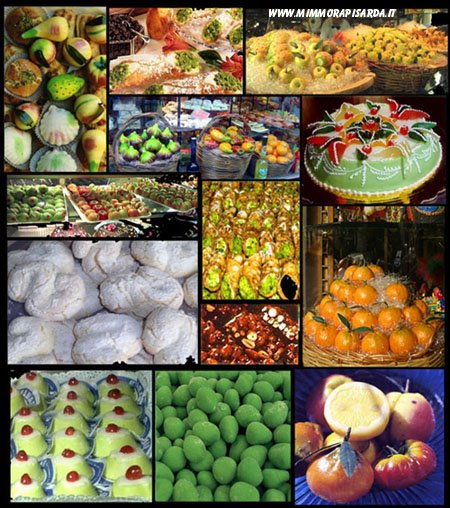
There's no better place to start exploring Sicily than at the heart of Palermo, in the island's oldest food market, La Vucciria. On this Saturday morning its narrow streets seem like a maze, lined with tables and crates stacked with bright pyramids: the satiny purple eggplants; pale green cucuzza squash like long curlicues; dark green artichokes; yellow citrons as big as grapefruits, and lemons as sweet as oranges; round sheep's-milk cheeses. I buy a few plums to eat as I walk; they are wrapped for me in a cone of rough paper, like a bunch of flowers.
My favorite stall is the deep-red one of tomatoes and peppers, the air around it exotic from sweet and salt, herbs and spice. Here the tomatoes come in every shape and guise: fresh; sun-dried; vine-dried, then tied in tangled bunches; preserved in oil; ground with herbs for pesto Palermitano; or pressed into salty slabs of concentrated paste — l'estratto — that are sold from an open tray by the spoonful. To accompany them are blisteringly hot peperoncini, woven strands of pink-veined garlic, and sprays of wild herbs.
"This area has been a market for centuries," explains Lia Verdina of the city tourist office. "Its name has evolved from boccheria — from the French boucherie, or butcher's — to Vucciria."
It's time for a midmorning snack, so we walk around piazzas ringed with palm trees and weave through chaotic traffic past eighteenth-century palaces to a bar known for its pastries. "Salato o dolce — savory or sweet?" asks Lia, opting for an arancina, a hot golden orb of rice that reveals a nugget of cheese at its center. It's hard to choose, but the cannoli look irresistible. The shells are filled with sweetened ricotta only after I order them, so they remain crisp to the last bite.
Our tour continues past the splendidly restructured Teatro Massimo opera house to the Kalsa, where Arab emirs lived a thousand years ago. One lofty section of an old wall has been strikingly converted into a cocktail bar, bookshop, and meeting place. It is a symbol of the rebirth of this once run-down quarter — at night, the streets around it are alive with restaurants and wine bars.
The autostrada west from Palermo toward Trapani follows the coast between imposing hills and sea so blue it's dazzling. I'm going to visit Marilù Terrasi, whose restaurant and hotel, Pocho, in the seaside town of San Vito lo Capo is renowned for its couscous. Called cuscusu in Sicily, this dish is an Arab legacy that is now the Trapani area's most popular meal. Indeed, San Vito lo Capo hosts an annual couscous festival, where cooks from around the Mediterranean compete.
"Our couscous is traditionally served with fish," explains Terrasi as I am served a heaping platter of it adorned with a host of sea creatures. "We season it with bay leaf, but some people also like it very piccante."
I drive on through seas of vineyards — Trapani produces more varieties of grapes than any other province in Italy — and then climb the steep, winding road to Erice. This stunning medieval hill town with narrow, intricately paved streets was built beside an ancient Greek temple dedicated to the bee goddess Aphrodite. This is the stuff of mythology: Virgil mentions the temple as a landmark in the Aeneid. Today, the views from Erice's peak are spectacular, and in summer its breezes are always cooling.
But there's another reason for my visit. I'm here for the delicious cookies and pastries that are produced by Maria Grammatico in her little shop. Grammatico learned her craft growing up in a convent, as did generations of sweetmakers before her. Grammatico's recipes, and the story of her life, have been published in Bitter Almonds, the book she wrote with Mary Taylor Simeti.
Down again, and a drive farther west toward Marsala by way of the coastal road that runs along the Mozia lagoon and past ancient — but still productive — salt flats. I love to come to this magical world halfway between sea and land. If you are lucky with the weather, you can have an aperitivo at the bar by the salt plant and watch the sunset reflected in the salt pans.
"Taking the best, mineral-rich salts from the sea and leaving the impurities behind is an ancient art," explains Giacomo D'Ali Staiti, who has restored a handsome sixteenth-century windmill here and created a salt museum. "It involves pumping sea water through a series of shallow insulated fields whose salinity increases under the hot summer sun until salt crystals form. The salt is then gathered into pyramids." At the end of the season, these large mounds are protected from the autumn rains with terra-cotta tiles. Without them, the salt would wash right back into the sea.
For dinner I treat myself to a plate of busiati — pasta that has been hand-rolled around a reed stalk to give it a spiral form. It is dressed with chunks of locally caught tuna and sprinkled with intensely aromatic capers preserved sotto sale — in sea salt.
It's lovely to explore the hills of southeast Sicily, where the extraordinary baroque towns of Ragusa, Modica, and Noto are situated. This landscape is unique, whatever the season — in spring when the pastures are colored by wildflowers, and in summer and autumn when their parched gold is broken only by the network of white dry-stone walls. Even the cattle blend into this monochromatic world of whites and browns. Their milk is used to make caciocavallo Ragusano, a well-salted firm cheese that is pressed into large rectangular blocks and matured hanging from ropes. A consortium has been formed to ensure that local farmers and artisans will continue to produce the cheese just as it has been produced for centuries.
Indeed, this is where some of Sicily's most interesting food artisans are to be found. In Modica, at Antica Dolceria Bonajuto, Franco Ruta makes pure, aromatic chocolate using the methods of the Aztecs. In Noto, maestro gelataio Corrado Costanzo carries on an ice cream tradition that was begun by the Arabs a thousand years ago using snow and infusions of jasmine and rose petals. Also in Noto, the Assenza brothers, at their Caffè Sicilia, produce a range of honeys scented with chilies, wild herbs, fruits, and spices. Their pastries range from classic favorites like cassata to innovative desserts that successfully use vegetables in place of fruit.
Such modern twists are not unusual in twenty-first-century Sicily. "Modern Sicilian cuisine bridges the gap between the future and the past," points out Ciccio Sultano, the talented young chef and owner of Ristorante Duomo in the ancient town of Ragusa Ibla. Sultano has built an inspired cuisine around the area's uniquely flavorful ingredients, like cherry tomatoes, pistachios, bitter almonds, and the delicate long-stemmed pears from Mount Etna. "There are excellent wild foods, too," he says, "from the herbs that have chosen to grow here — fennel, mint, thyme, and oregano — to the game, mushrooms, wild berries, and chestnuts."
My final stop, the pretty fishing port of Syracuse on the east coast, is a good place to find the varieties of Mediterranean fish that star in so much of the island's cucina. Swordfish — traditionally caught in the Strait of Messina — and tuna are often accompanied by tomatoes, as well as raisins and pine nuts, mint and garlic, or capers and olives. Sardines, red mullet, and inky squid are popular, abundant, and affordable. They are best when cooked with delicate Sicilian extra-virgin olive oil — never butter — and eaten with chewy fresh bread.
From the port, I walk across the bridge to the tiny, beautiful island of Ortigia, where the city center is located. Its creamy-pink streets are full of restaurants, shops, and wonderful architecture, like the baroque cathedral, which was built on the site of a Greek temple to Athena and houses a medieval church within it. The piazza here is a great place to sit, have a glass of the local wine, and watch the passeggiata, the parade of couples and families out for an evening stroll.
And it's a great place to reflect on Sicily's ancient allure. Here, in this city, are some of the best of the Greek archaeological ruins — Syracuse was one of the most important cities in the western world for more than a thousand years. Those ruins are now surrounded by a modern city and, beyond that, by orange and lemon groves that fill the Sicilian air with their exquisite perfume.